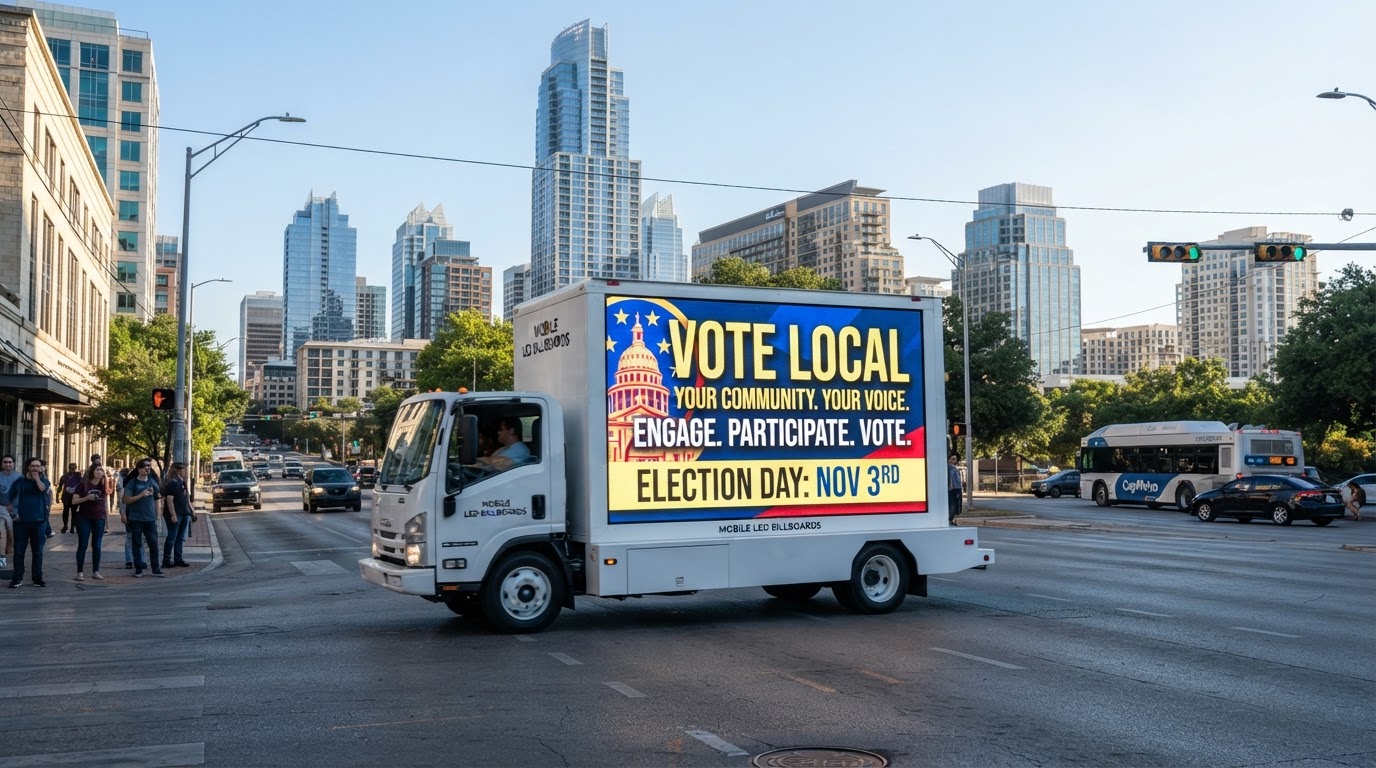
Political billboard advertising can help campaigns create physical visibility across selected districts, neighborhoods, commuter corridors, events, and legally permissible locations. Mobile LED billboard trucks add route and scheduling flexibility compared with fixed outdoor placements, letting campaigns move messaging to where voters live, work, and gather. This guide covers timing, strategy, creative, compliance, measurement, and cost, without guaranteed performance claims.
The 2026 Texas Election Window Is Already Here
Campaign messaging and media strategy should shift as Election Day approaches. Early phases build recognition; later phases drive early voting and final turnout. Key Texas dates for the 2026 general election:
- October 5, 2026: Voter Registration Deadline
- October 19, 2026: Early Voting Begins
- October 23, 2026: Ballot-by-Mail Application Deadline
- October 30, 2026: Early Voting Ends
- November 3, 2026: Election Day
Confirm current dates with the Texas Secretary of State as the authoritative source.
Where Political Billboard Advertising Fits Into a Campaign
Outdoor advertising supports many campaign goals: candidate recognition, issue awareness, ballot measures, campaign events, rallies, early voting reminders, voter education, GOTV visibility, and community outreach.
It complements (not replaces) digital ads, social media, direct mail, field organizing, broadcast, and earned media. For broader context, see our political campaign advertising solutions.
How to Plan Political Billboard Advertising Across the 2026 Election Cycle
Phase 1: Build Recognition
Introduce the candidate or issue early. Focus on name ID and a clear message across key neighborhoods and commuter corridors.
Phase 2: Reinforce the Message
Highlight key issue positions and contrasts. Rotate creative to keep attention while maintaining core campaign identity.
Phase 3: Support Early Voting
Promote early-vote dates and polling sites. Route trucks near early-voting locations and high-turnout districts.
Phase 4: Final Election Push
Maximize GOTV visibility on Election Day with urgent vote reminders near key transit hubs and voting corridors.
How to Plan Mobile Billboard Routes in Texas
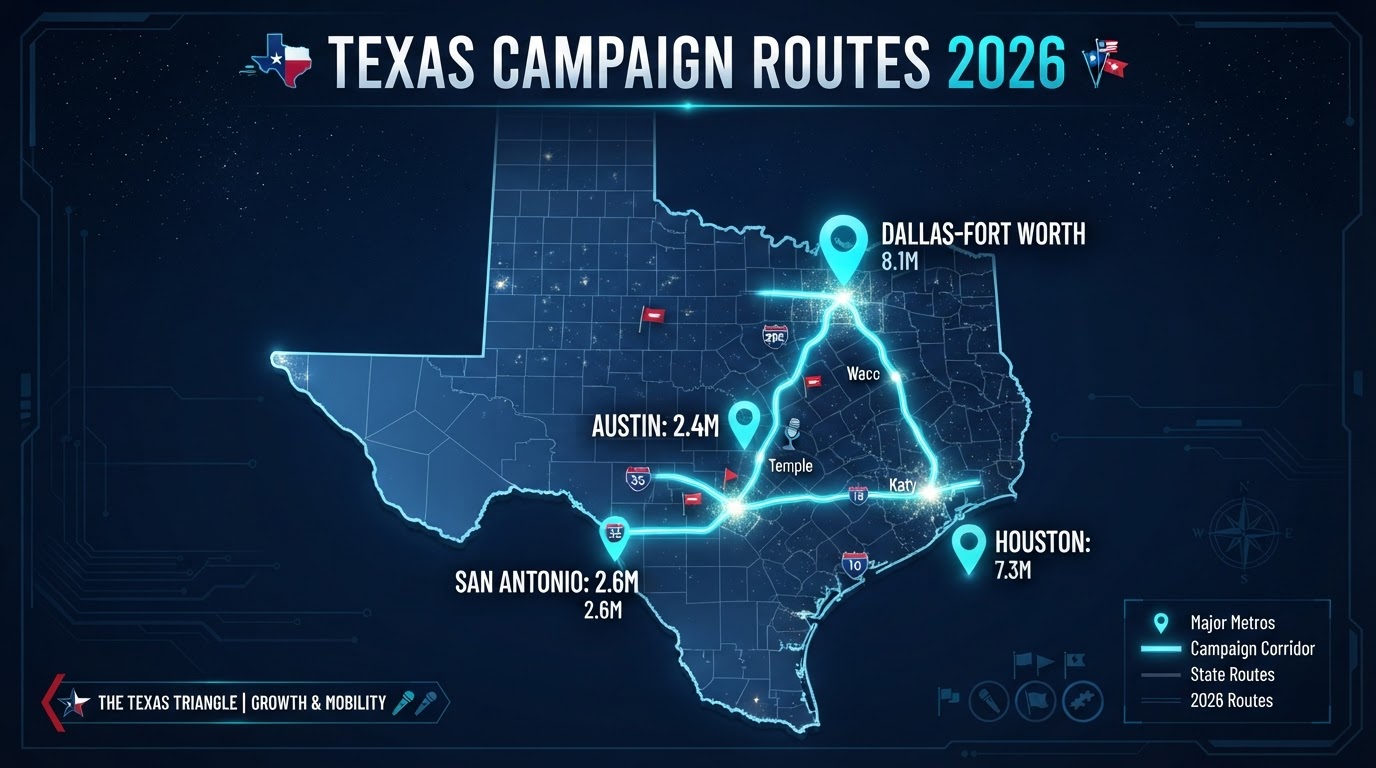
Route planning should align with campaign geography, timing, and audience movement. Consider district boundaries, priority neighborhoods, commuter corridors, commercial districts, campaign events, community gathering areas, major activity centers, and legally permissible roads.
Important: More traffic does not automatically mean better targeting. Routes, stopping points, parking, polling locations, and venue access must comply with applicable election, traffic, venue, and local regulations.
Political Billboard Creative Has Seconds to Communicate
Effective creative uses one primary message, large typography, strong visual contrast, clear candidate or issue identification, minimal copy, one simple CTA, a visible disclosure area, and is readable without sound.
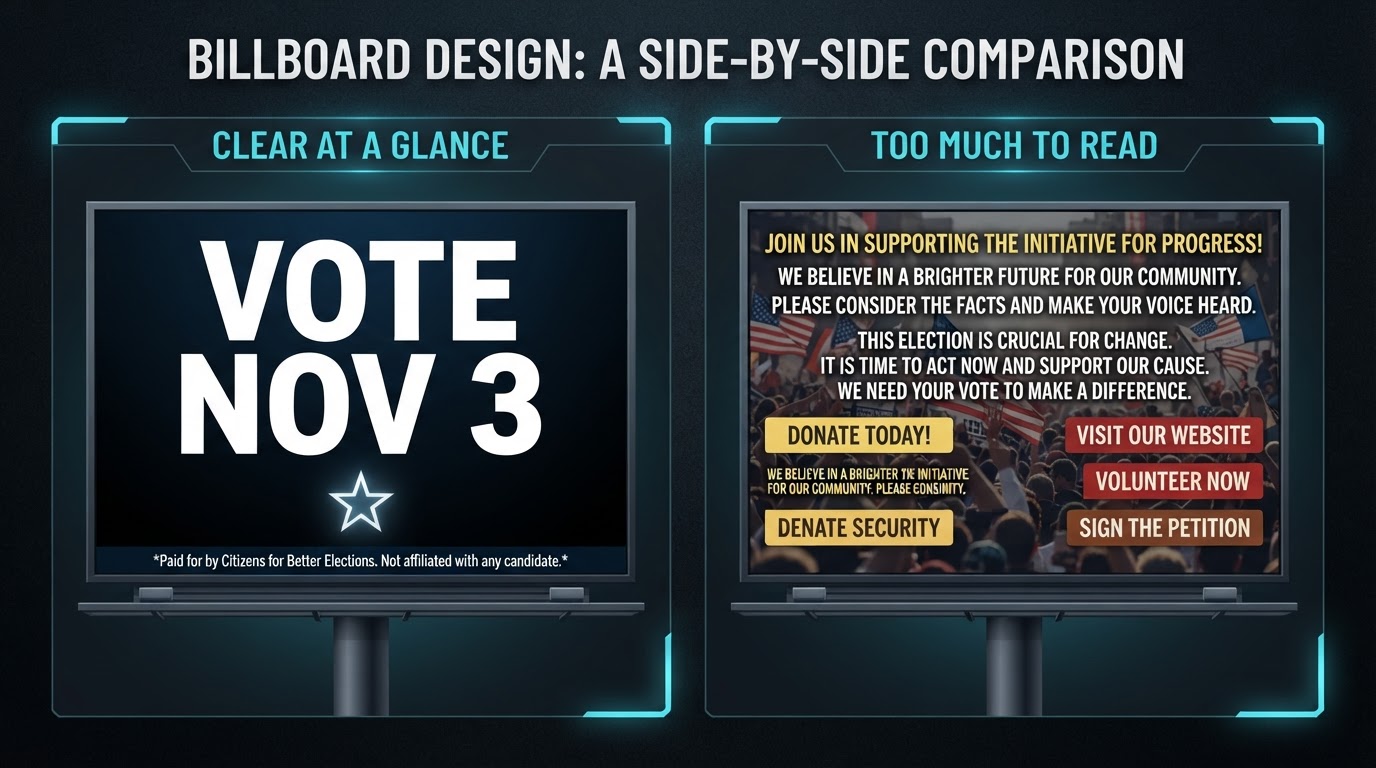
Fictional creative shown for illustration only: no real candidates, parties, or slogans depicted.
Political Advertising Rules Texas Campaigns Should Review
Texas Disclosure Requirements
Applicable political advertising may require disclosure language identifying the responsible payer, political committee, or candidate.
Federal Requirements
Federal political advertising may carry additional FEC disclaimer requirements. Confirm which rules apply to your race.
Polling-Place Restrictions
Campaigns must respect electioneering boundaries and polling-place rules. Distance limits vary by jurisdiction.
Roads & Placement
Highway rights-of-way, parking, and local placement restrictions may apply. Route plans should account for these limits.
This section provides general informational guidance and is not legal advice. Campaigns should confirm current federal, state, local, venue, and election-specific requirements before launch.
Mobile LED Trucks vs. Static Billboards vs. Digital Political Ads
| Factor | Mobile LED Trucks | Static Billboards | Digital Political Ads |
|---|---|---|---|
| Geographic flexibility | High (routes move) | Low (fixed) | High (by audience) |
| Creative change speed | Fast (digital) | Slow (printed vinyl) | Instant |
| Physical visibility | Large, street-level | Large, roadside | Screen-based |
| Fixed-location repetition | Limited | Strong | N/A |
| Audience targeting | Route-based | Location-based | Data-based |
| Campaign timing | Scheduled routes | Continuous | Flexible |
| Reporting options | Route + estimated impressions | Circulation estimates | Detailed digital metrics |
| Ideal use | Movable visibility | Sustained presence | Precise retargeting |
Geographic flexibility
Mobile LED: High (routes move)
Static: Low (fixed)
Digital: High (by audience)
Creative change speed
Mobile LED: Fast (digital)
Static: Slow (printed vinyl)
Digital: Instant
Physical visibility
Mobile LED: Large, street-level
Static: Large, roadside
Digital: Screen-based
Fixed-location repetition
Mobile LED: Limited
Static: Strong
Digital: N/A
Audience targeting
Mobile LED: Route-based
Static: Location-based
Digital: Data-based
Campaign timing
Mobile LED: Scheduled routes
Static: Continuous
Digital: Flexible
Reporting options
Mobile LED: Route + estimated impressions
Static: Circulation estimates
Digital: Detailed digital metrics
Ideal use
Mobile LED: Movable visibility
Static: Sustained presence
Digital: Precise retargeting
How to Measure a Political Mobile Billboard Campaign
Delivery
- Routes completed
- Operating hours
- Markets covered
- Campaign photos
Exposure
- Estimated impressions
- Geographic coverage
- Route frequency
- Time-of-day exposure
Response
- Landing-page visits
- QR interactions
- Branded search
- Volunteer signups
Exposure does not prove how an individual voted. This guide makes no claims of guaranteed votes, turnout, ROI, or election outcomes. See our impression tracking overview for more on measurement.
What Affects Political Billboard Advertising Cost?
We don't publish flat rates because no two campaigns are alike. Cost varies with:
2026 Texas Political Billboard Planning Checklist
- Define campaign objective
- Confirm office / issue / measure
- Map campaign geography
- Confirm election dates
- Identify priority markets
- Identify priority corridors
- Prepare creative versions
- Complete compliance review
- Review polling-place restrictions
- Set campaign dates and hours
- Confirm truck availability
- Define reporting
- Prepare alternate routes
Save this checklist before planning your campaign.
Common Political Billboard Campaign Mistakes
- Targeting the wrong geography: high traffic does not equal the right voters.
- Overcrowding billboard creative with too much copy and competing messages.
- Leaving required disclosures until the end of the design process.
- Booking election-week inventory too late when demand peaks.
- Using the same message through every phase instead of evolving it.
- Treating estimated impressions as confirmed votes or turnout.
- Planning routes without reviewing local placement and polling restrictions.
