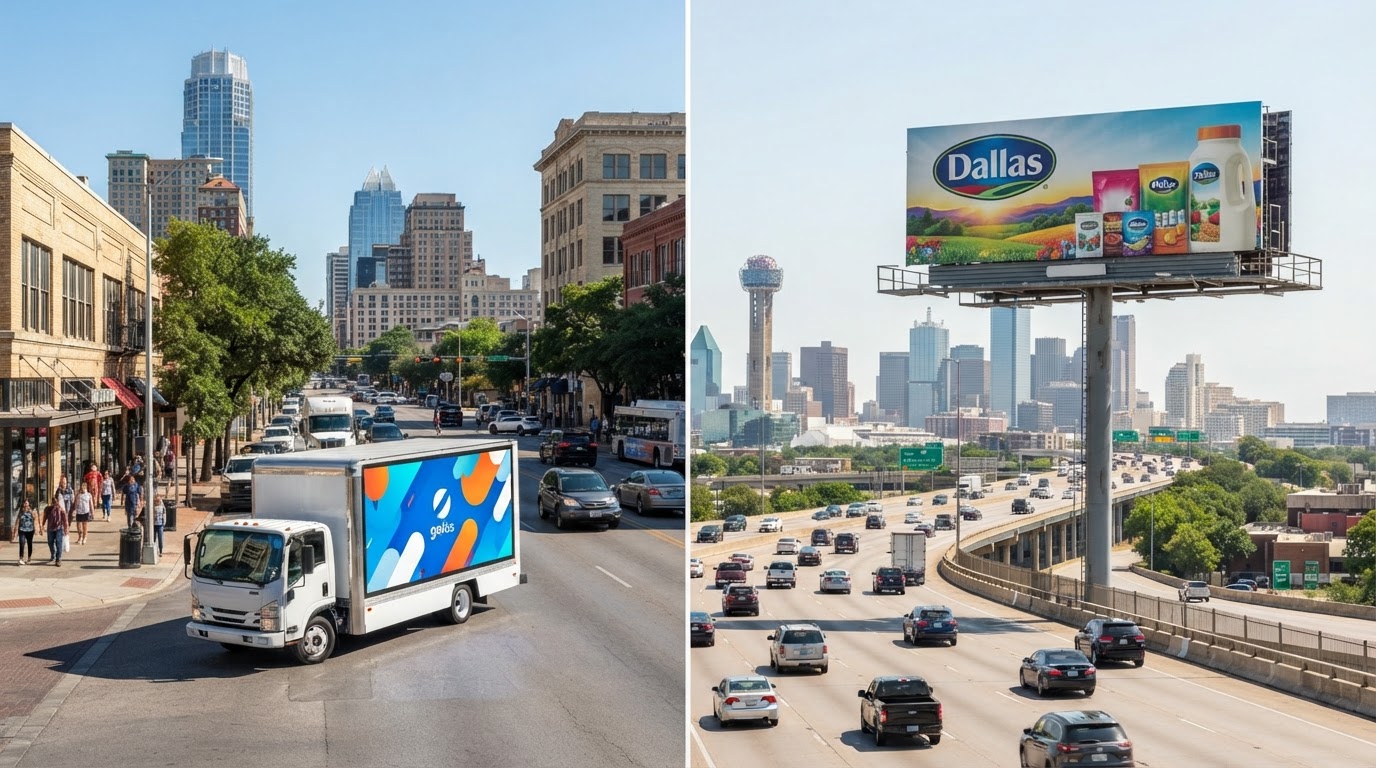
Mobile billboards are usually the better fit when routes, timing, events, or campaign geography need to change. Static billboards are stronger when one fixed location and long-term repeated exposure matter most. Neither format is universally better, and some campaigns can benefit from both.
Mobile Billboard vs. Static Billboard at a Glance
Both formats offer immense physical presence in outdoor advertising, but their operational models, flexibility, and strategic advantages differ fundamentally.
| Factor | Mobile Billboard | Static Billboard |
|---|---|---|
| Location | Moves across planned routes and target areas | Fixed at a single physical location |
| Audience Targeting | Targets specific neighborhoods, events, and hours | Reaches traffic passing one specific point |
| Geographic Flexibility | Covers multiple corridors and districts daily | Zero movement after installation |
| Creative Flexibility | Fast digital updates across dayparts or campaigns | Requires vinyl reprints and physical re-installation |
| Measurement | GPS route verification and estimated exposure logs | Traffic counts and Daily Effective Circulation estimates |
| Best For | Launches, events, timely promotions, and multi-area reach | Continuous highway presence, directional, and sustained recall |
Location
Mobile: Moves across planned routes and target areas
Static: Fixed at a single physical location
Audience Targeting
Mobile: Targets specific neighborhoods, events, and hours
Static: Reaches traffic passing one specific point
Geographic Flexibility
Mobile: Covers multiple corridors and districts daily
Static: Zero movement after installation
Creative Flexibility
Mobile: Fast digital updates across dayparts or campaigns
Static: Requires vinyl reprints and physical re-installation
Measurement
Mobile: GPS route verification and estimated exposure logs
Static: Traffic counts and Daily Effective Circulation estimates
Best For
Mobile: Launches, events, timely promotions, and multi-area reach
Static: Continuous highway presence, directional, and sustained recall
What Is the Difference Between a Mobile and Static Billboard?
What Is a Mobile Billboard?
A mobile billboard is large-format advertising mounted on a commercial vehicle or dedicated truck chassis. Modern units frequently use high-resolution LED screens, though printed vinyl wraps are also common. Instead of staying in one place, the truck navigates strategic routes through chosen corridors, neighborhoods, and event perimeters during targeted daily hours.
Explore Mobile Billboard AdvertisingWhat Is a Static Billboard?
A static billboard is a permanent, fixed outdoor advertising structure positioned alongside roadways, highways, or building facades. Once installed, it remains in that single physical position throughout the contract. Static billboards can display printed vinyl or electronic digital graphics that rotate with other advertisers on a short loop.
Explore LED Billboard TrucksMobile vs. static describes whether the advertising moves. Digital vs. printed describes the display technology. A mobile or fixed billboard can use either digital or printed creative.
When Mobile Billboards Make More Sense
Mobile billboards thrive when audience location shifts throughout the day, when timing is critical, or when short-term momentum matters more than permanent real estate.
Grand Openings & Product Launches
Circle nearby shopping centers and feeder roads to build immediate buzz around a new location or release.
Events, Sports & Festivals
Meet captive crowds outside arenas, convention centers, and festivals during peak arrival and departure hours.
Multi-Neighborhood Coverage
Rotate routes between distinct commercial nodes, such as Uptown, Downtown, and Midtown, within the same week.
Time-Sensitive Campaigns
Align ad messages with specific peak commuter windows, weekend nights, or critical campaign dates.
When Static Billboards Make More Sense
When one location delivers the exact audience you need, a fixed board delivers continuous value.
Long-Term Brand Awareness
Anchor your brand in the minds of daily commuters month after month from one landmark position.
Major Commuter Corridors
Maintain an unmissable presence along high-volume interstates where daily traffic is guaranteed.
One Strategic Location
Own a signature geographical vantage point where competitor outdoor presence is scarce.
Fixed-Location Repetition
Ideal when your customer base consistently travels the same arterial roadway every single day.
Which Format Reaches the Right Audience Better?
Mobile Audience Reach
Moves through selected retail districts, office clusters, and event corridors during high-traffic hours, meeting the audience where they live, shop, and gather.
Static Audience Reach
Captures everyone traveling along one physical road, building high repetition among daily commuters who pass the same board.
Key insight: More traffic does not automatically mean better targeting. The stronger placement is the one that overlaps with the audience, geography, and timing that matter to the campaign.
Mobile vs. Static Billboard Cost
Neither format has a flat universal price. Understanding the cost components helps you evaluate bids and avoid hidden production fees.
For a deep dive into campaign pricing drivers, see our complete guide to mobile billboard advertising costs.
Mobile Billboard Cost Factors
- •Campaign duration (single-day event vs. multi-week flight)
- •Daily operating hours (standard shift vs. extended run)
- •Target market and local operating permits
- •Route complexity and distance traveled
- •Truck and display type (LED digital vs. static vinyl wrap)
Static Billboard Cost Factors
- •Specific board location and road visibility rating
- •Market size and traffic density
- •Booking contract length (4-week period vs. annual commitment)
- •Physical structure size and illumination
- •Vinyl production, printing, installation, and take-down fees
Buying advice: The cheapest headline quote is not always the lowest-cost campaign. Compare what is actually included, such as production, installation, operating hours, route planning, and reporting.
How Do You Measure Mobile and Static Billboard Campaigns?
Both formats can be evaluated across three distinct performance layers:
Did the campaign run as planned?
GPS route logs, driver operating hours, and date-stamped campaign photos in real operating environments.
Physical completion photos and lighting inspection reports confirming the vinyl remains mounted and illuminated.
How much potential audience exposure occurred?
Estimated impressions based on route path, traffic density at scheduled hours, and geographic coverage area.
Daily Effective Circulation (DEC) and Department of Transportation annual average daily traffic counts.
Did audience behavior change?
Dedicated QR codes, campaign URLs, promo codes, regional web traffic lifts, and geo-targeted search spikes.
Custom phone numbers, directional foot-traffic at exits, and long-term brand recall surveys.
Remember: Estimated impressions and exposure should not automatically be treated as conversions or ROI. For a detailed breakdown of campaign metrics, explore our impression tracking overview.
Which Format Is Better for Different Campaign Goals?
Use this decision matrix to evaluate how each medium aligns with your primary marketing milestone:
| Campaign Goal | Mobile Billboard | Static Billboard |
|---|---|---|
| Grand Opening / Product Launch | Drives immediate foot traffic and buzz directly around venue locations and nearby feeder corridors. | Provides broad advance awareness if high-visibility inventory is available near the site. |
| Event / Short-Term Promotion | Targets captive crowds outside stadiums, convention halls, and festivals during peak arrival hours. | Limited to existing stationary boards on major approach routes with long contract minimums. |
| Multi-Neighborhood Local Campaign | Rotates through multiple commercial corridors and priority neighborhoods within a single scheduled week. | Requires purchasing and producing separate stationary billboards across each target district. |
| Long-Term Brand Awareness | Builds sustained regional familiarity by circulating across high-volume commuter routes on schedule. | Delivers uninterrupted 24/7 landmark visibility and high repetition for daily commuters passing by. |
| Major Highway / Single Strategic Location | Travels within the highway traffic flow during peak morning and evening commuter congestion windows. | Provides permanent, towering sightlines directly overlooking key interstate interchanges. |
Grand Opening / Product Launch
Mobile: Drives immediate foot traffic and buzz directly around venue locations and nearby feeder corridors.
Static: Provides broad advance awareness if high-visibility inventory is available near the site.
Event / Short-Term Promotion
Mobile: Targets captive crowds outside stadiums, convention halls, and festivals during peak arrival hours.
Static: Limited to existing stationary boards on major approach routes with long contract minimums.
Multi-Neighborhood Local Campaign
Mobile: Rotates through multiple commercial corridors and priority neighborhoods within a single scheduled week.
Static: Requires purchasing and producing separate stationary billboards across each target district.
Long-Term Brand Awareness
Mobile: Builds sustained regional familiarity by circulating across high-volume commuter routes on schedule.
Static: Delivers uninterrupted 24/7 landmark visibility and high repetition for daily commuters passing by.
Major Highway / Single Strategic Location
Mobile: Travels within the highway traffic flow during peak morning and evening commuter congestion windows.
Static: Provides permanent, towering sightlines directly overlooking key interstate interchanges.
Can Mobile and Static Billboards Work Together?
Mobile and static billboards are not mutually exclusive. A static board provides ongoing market presence, while a mobile truck handles short-term launch or event activation.
Real-world example: A retailer opening a new location may use a mobile billboard around nearby shopping and commuter corridors during launch week, while a business seeking year-round exposure along one major highway may prefer a static billboard.
Which Billboard Format Should You Choose?
Save or screenshot this practical decision checklist when planning your next outdoor advertising media buy:
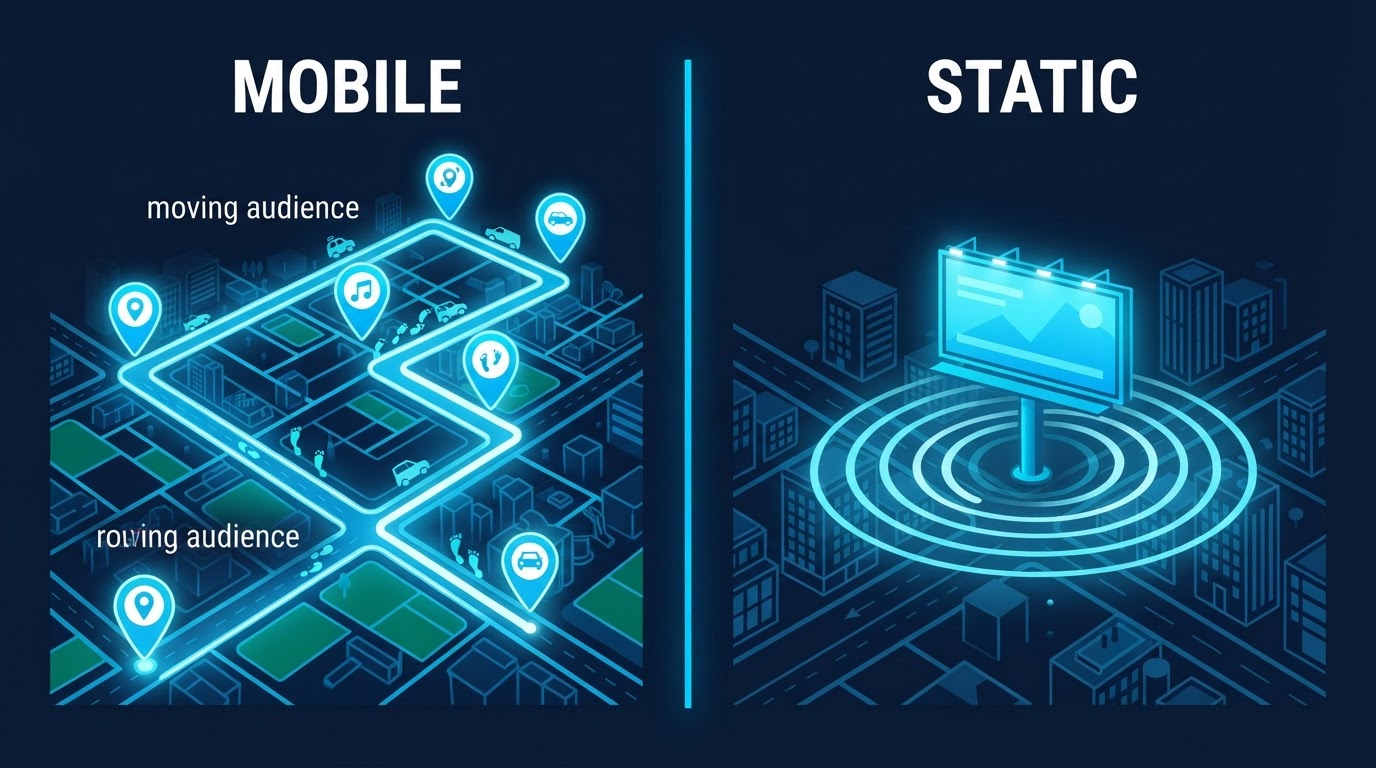
Choose Mobile If:
- Multiple locations matter to your campaign
- Timing or events matter
- The campaign is short or flexible
Choose Static If:
- One location matters most
- Long-term repetition matters
- Campaign geography stays fixed
Consider Both If:
- You want ongoing market awareness
- Plus short-term launch or event activation
Common Mistakes When Comparing Mobile and Static Billboards
Comparing Only the Headline Price
A low static lease can seem cheaper until you add vinyl printing, freight, installation, and an inflexible 4-week commitment.
Assuming More Traffic Means Better Targeting
A board with 100,000 daily cars is wasted if most drivers are outside your service territory. Relevance beats raw volume.
Confusing Mobile with Digital
Mobile vs. static is about movement. Digital vs. printed is about the display surface. Both formats can use LED or vinyl.
Treating Exposure Estimates as Conversions
Neither mobile nor static impressions guarantee purchases. OOH builds awareness that supports digital response.
Picking the Format Before Defining the Goal
Always start with audience geography, campaign dates, and message objectives before choosing mobile or static.
